
This essay is an edit of a tweet originally posted to Twitter on September 9, 2025. It has been edited lightly for long-essay format.
I don’t usually get into a taxis in China with the intention of discussing a certain topic, or investigating a specific theory. It takes something away from the spontaneity of the conversation, and if I do it too often, I figure my readers are likely to start doubting the authenticity of the interactions. But in special cases, I will go into a taxicab conversation with a bit of intentionality. One case is when there’s some kind of ongoing discourse about what Chinese taxi drivers themselves - partially if the discourse is about what Chinese taxi drivers think, or believe. After all, if I come across a claim concerning Chinese taxi drivers that I’m not sure sure about, who better to ask?
Like the one below, for example:
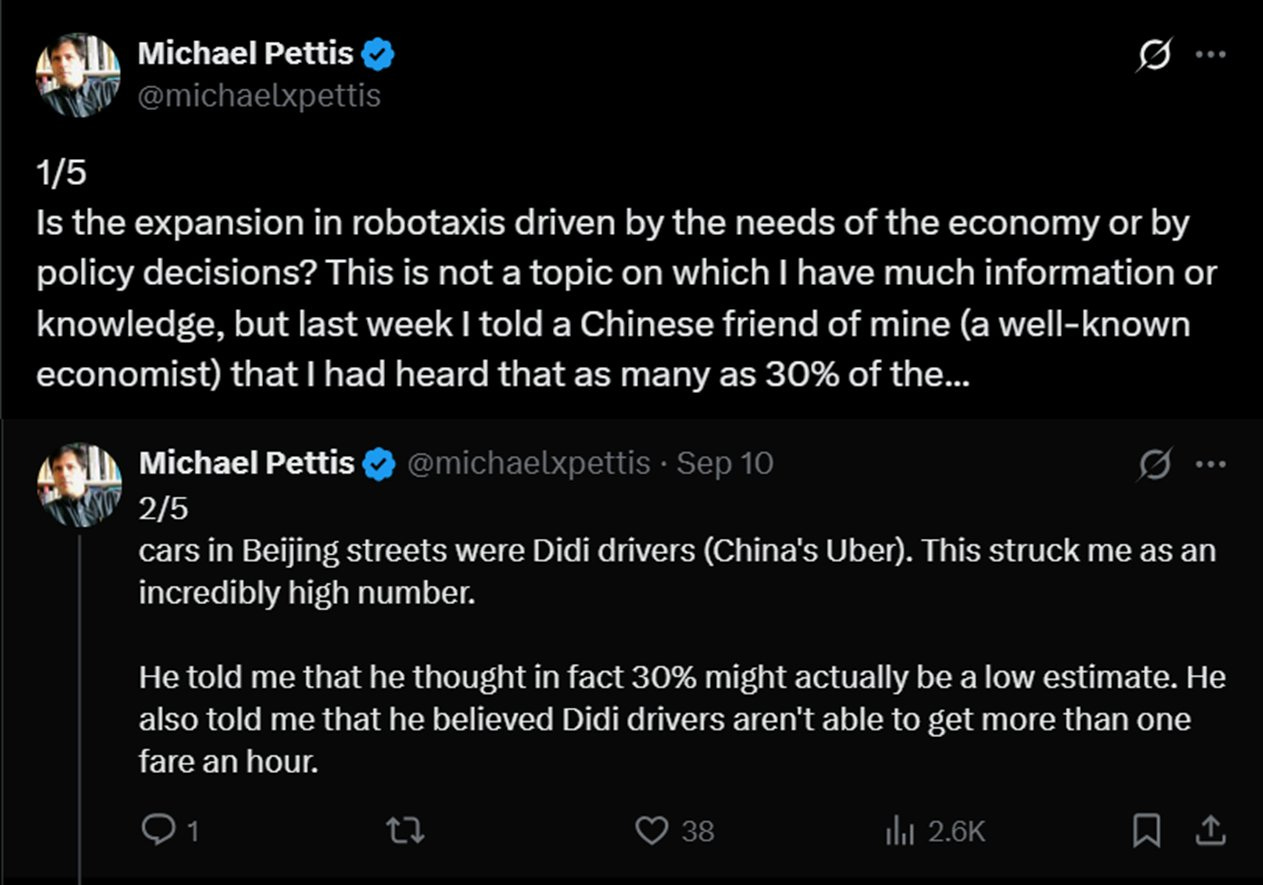
I happened to see the tweet in the screenshot while on a work trip in Hangzhou, exactly at that moment sitting in a Didi (rideshare) car on my way to a meeting. So I naturally had to immediately ask my driver what he thought.
Hangzhou Driver 1/2: Proud Dad and Urban Maximalist Cao Shifu
“Hey shifu, how many rides do you do in an hour?”
“Uhm. Maybe one. Or more, if they are short. My revenue is about 500 CNY per day. I’ll keep 300 CNY per day, after my expenses.
“So, you’re living on 300 CNY per day?”
“No, what I mean is 300 per day is what I have left, after I pay all my living expenses. I spend about 200 CNY a day on food, rent, expenses, etc.”
If he works 26 days each month (resting one day per week), then he grosses around 13,000 CNY a month. Spending 6,000 a month, he is able to save 7,000.
“Ah so you own your own car? No car rental?” [many Didi drivers in large cities lease their vehicles, which would cut into his ability to save]
“Yes, that’s right.”
“In what situation would your rides drop to only one per hour? Is it because of a traffic jam, causing the ride to take longer? Or not enough people calling for a driver, so you have gaps between orders?”
"There are too many drivers now. There's basically no entry requirement to become a driver...anyone can do it (“门槛太低了”). As long as you have a car and want to drive, you can. So now we have too many drivers."
"Why so many drivers? What were the drivers doing before this?"
"Oh you know. Building real estate. But now the market for real estate is bad, because it's saturated. There's no demand for houses, because Chinese people basically all own a house. Home ownership is over 90%, you know"
"Do you mean the old houses...the village house?"
"No, I mean at least in the county-level city. Chinese people basically all have a urban house in at least the county-city (县城) now. So there's no demand for it anymore."
With official urbanization rates lower than 70%, and high-quality urbanization rates likely closer to 50%, I know this isn't true on a nationwide basis, but it was nonetheless interesting to hear this theory.
He continued: "Except for some people in those places like Xinjiang, Tibet, Inner Mongolia. They don't have the demand for an urban house, because they have a different kind of lifestyle, you know, like nomadic herders. But all the other Chinese people already own an urban property, so there's no more demand for houses. That's why the real estate market is bad. That's how I understand it. So the workers who used to build houses now instead deliver takeout or parcels, or drive for Didi."
“So I guess you have an urban property already too?”
“Yes, that’s right. My parents helped me with the down payment.”
“So now you’re paying off the loan?
“No, it’s already paid. I own my house already.”
“Okay...well I guess you aren’t from Hangzhou. Where did you buy?”
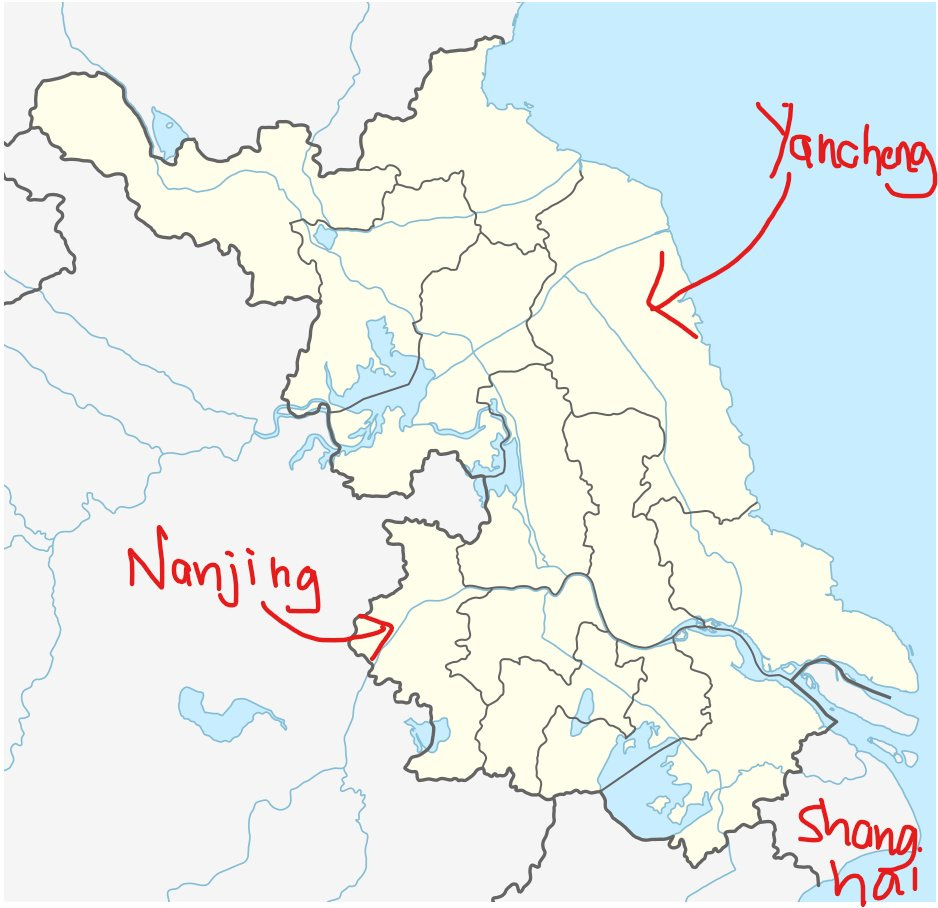
“I’m from Jiangsu...Yancheng City. Property in Yancheng is much cheaper than Hangzhou. Hangzhou property is 30k, 40k per square meter. In Yancheng, it’s just 7k...or maybe 10k in the city center.”
Yancheng is a not-very-notable coastal city in northern Jiangsu with about 7m people, 2m of them in the metro downtown area. Jiangsu is a wealthy province, but Yancheng is in the lower half of the provincial rankings by development level. I don't know whether it’s true in Yancheng that "just about everyone has already bought an urban house", especially because Yancheng's urbanization rate is level with the national average. It seems doubtful to me, but I haven't been there.
If this claim were to be true anywhere, I could see it being true in a smaller city in a wealthier province where urban real estate has remained fairly affordable. It might be true that demand for new urban housing in a place like Yancheng IS getting close to the saturation level, but it would require a far more involved research effort than a sample of one driver in Hangzhou...
By the way, Yancheng's name means "salt city" and was historically famous for producing salt. It also notably had a horrible explosion at a chemical industry park in 2019 that caused a lot of fatalities. And that's literally every single thing I know about Yancheng.
"So if you already have a house, fully paid off, why are you still working in Hangzhou, driving a car for such long hours, netting just 300 CNY per day? Couldn't you go back to Yancheng and relax? The salary will be lower, but your stress will be lower. You can start to tangping.” (躺平, or “lie flat"; leave the rat race and take it easy).
"I can't tangping yet. I have to think about the next generation. If I went back to Yancheng, it's true my life would be much more relaxed. But here, I can save 300 a day to put away for my future, to enjoy when I retire. In Yancheng, my salary would be lower, and probably I could only save 200 per day. I’d have an easier life now, but I want to make sure I have enough savings so I can live a really good retirement, not just passing the days."
"When you say the next generation, are you also thinking about buying a house for your child?"
"No, I don't have to worry about that. My parents have a house, and I already bought a house, so we have two in the family now. That's enough. If we need, in the future I can live in my parents' house and my daughter will live in my house. My daughter is only 16, so I will keep worrying about her until she is married and has her own family. Perhaps I can tangping after she is married."
"Is your daughter in Yancheng? Or Hangzhou?"
"She's in Hangzhou here, with me and my wife. She's in the first year of senior high school now."
"Did you ever have any trouble with sending her to school to Hangzhou...because your hukou is not from here...it's from Yancheng right?"
"Ah, that's not a problem. I have paid many years of social insurance in Hangzhou. But also, you know...honestly...if you are a very good student, even the best schools will accept the student, even if they are from another city."
Here, he let out a proud fatherly chuckle, the only emotion he showed during our conversation.
"If the high school believes the student will definitely go to a top college, and help improve their rankings, they don't care where your hukou is from. They will think of a way to allow them go to school there. heh heh...
...and my daughter is a VERY good student!"
We arrived at my destination, I thanked Cao Shifu, and the ride ended.
That’s part 1. It was a shorter one, so I combined it with Part 2 to continue exploring the same theme of the rideshare economy in Hangzhou. I took this second Didi ride on the very next day (September 10, 2025), kicking off the conversation with the same theme.
Hangzhou Driver 2/2: Rideshare Economics and Jewelry Industry Secrets with Xia Shifu
“Hey shifu, how many rides can you do in a single hour normally?”
“It varies. Sometimes 4. Sometimes 0. Depends what the system gives you.
“So you might have long gaps between rides?”
“During the day, sure. At the evening peak rush, no.”
“That’s right, there are surge periods and flat periods. That makes sense.”
“There are more Didi drivers than passengers during the trough periods in the afternoon. That’s when the price is low and we don’t get a lot of rides. But in the evening peaks, you will accept the next ride even before you finish the previous one. In one day, I can usually make around 500. It’s more in the summer vacation...on those days it should be at least 600 per day.”
“What’s the most profitable time to drive?”
“At night. The fares are higher, and there are fewer drivers. I would like to drive at night to make more money, but my wife won’t let me. She says it’s dangerous to drive long hours at night.”
“This model for rideshare pricing reminds me of my own industry. I work in the electricity industry, and power has a different price at each hour of the day based on real-time supply and demand.”
“Oh, like how charging my EV at night is very cheap. Yes, driving for rideshares is similar. We have peak prices, shoulder prices, and trough prices. But not so granular, like for electricity. It doesn’t change every hour.”
“You know, you could optimize your driving habits. Don’t bother driving when fares are low, and maximize your effort when fares are high.”
“Well, I take all the fares. As long as I can make 500 a day, it’s okay. I own my car, so my expenses are lower. I can normally gross 12k-15k CNY in a month.”
“And you’re driving full-time?”
“Yes, full-time”
“I guess you weren’t driving before this...right?”
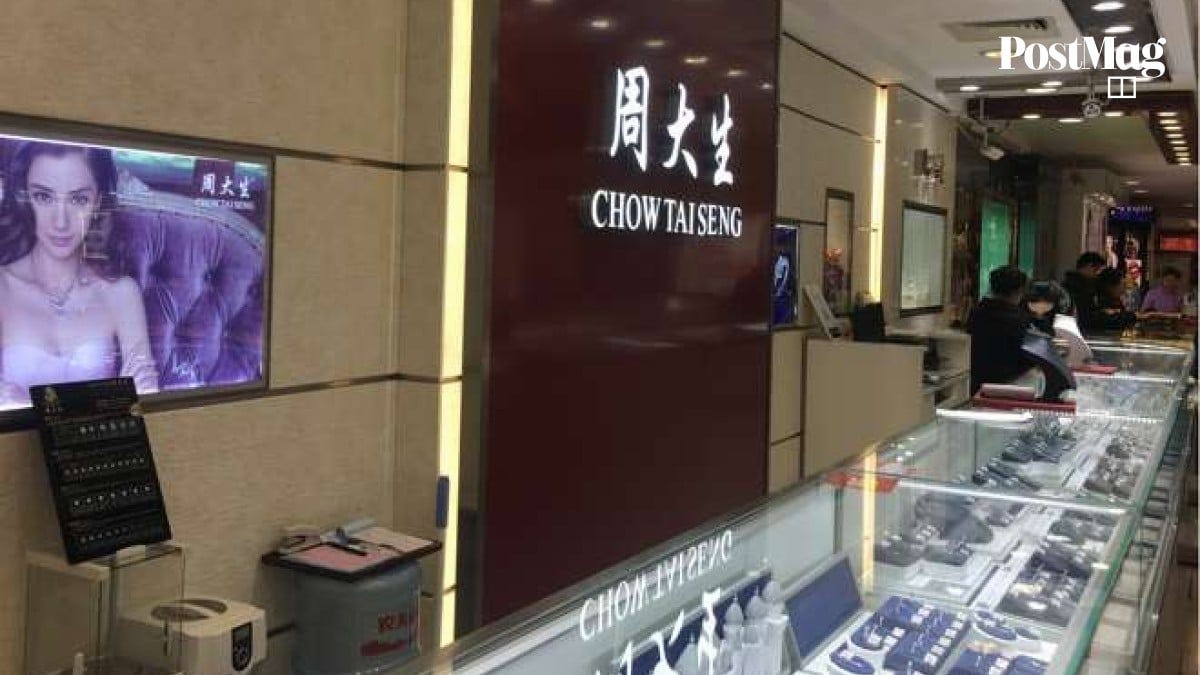
“Right. I was driving part-time before, but I had another full-time job. I lost my job, so I became a full-time driver. I was a manager in the gems and jewelry industry. You know Chow Tai Seng?” (周大生)
“Oh, isn’t it one of those Hong Kong jewelry chains...?”
“Actually no. Chow Tai Seng is from Beijing, but the brand’s direction tries to be close to the Hong Kong brands. The 4 famous Hong Kong brands are Chow Tai Fook, Chow Seng Seng, Luk Fook, and TSL.” (周大福、周生生、六福、谢瑞麟)
“What about Chow Luk Fook?” (周六福)
“Actually that’s from Shenzhen”
“Ooookay. I’m confused. They all sound so similar. I only remember seeing these brands in the mall when I was looking for my wife’s engagement ring, and always got them mixed up. So you say you were at...Chow...Tai...Seng?”
“That’s right.”
“What happened?”
“I got fired lah. Management cut half of the staff in the Hangzhou corporate office, from 20 people down to 10 people. The gems industry is not so good right now.”
“When did this happen?”
“This year. Just a few months ago.”
“Are you from Hangzhou? Or did you consider going back somewhere to your hometown?”
“No, I’m from Hangzhou. In the suburbs.”
“Did you expect this was coming, or was it a surprise?”
“It was a surprise! We got one month’s notice, and then I was done. I thought the gems and jewelry business would be stable, because people tend to buy these things when they are unsure about the economy, but I guess it’s not true.”
“What about Laopu Gold? I heard this brand is doing very well right now.”
“Ahh, yes. Laopu Gold is doing very well. They have a very special sales angle. They have done a good job to make the items very fashionable and artistic, and connect them with Chinese culture. So if you can buy it for the art and cultural value. But then it also happens to be made of gold, so it will keep its value as a precious metal. It’s a good business strategy.”
“I’ve always felt the traditional jewelry stores are expensive and not very good value. Because you are paying for their branding, marketing...rent...etc. And you can’t easily find some unique or specialty items.”
“Yes, this is a problem in the gems industry. You are paying a premium price for a mass-market item. We always have to pay for the most strategic sales location on the pedestrian streets, or in the malls, so that’s part of our costs.”
“When I was shopping for my wife’s engagement ring, I directly asked her what kind of ring she would like. I didn’t want to get her something she didn’t want. And it’s a good thing I asked, because I never could have guessed what she wanted. She said she wanted a peach sapphire for her gem. But this is a rare gem - none of the big brands I visited even had one to show me. I had to go to a small custom jeweler to get it made.”
“Wow, that’s very unique. Yes, I would be surprised if all the Chow Tai Seng stores in Hangzhou combined even had one peach sapphire in stock. Sapphires are becoming very popular right now - and desire for diamonds is decreasing. Everyone realizes now that diamonds don’t actually have any value, but also lab-made diamonds are pushing the price down. On the other hand, even a lab-made sapphire is still very expensive, so sapphires will keep their value better. Especially a rare color like peach.”
“Yes, I guess they’re only from one place? Sri Lanka? that’s what it said on my gem certificate.”
“Yes, Sri Lanka.”
“So what did your other colleagues do, after your company cut staff?”
“Someone of them went back to their hometowns to find jobs. Some got rehired back into the stores. They are young, so they can still go work in the retail locations. One of them is now selling Teslas.”
“What about you? What’s your plan next? Just keep driving?”
“I’m 40. I’ve spent my whole career in the jewelry business, but I can’t go back to work in the retail locations now like the young kids. I could go work for one of the other big chains...I should be able to find a job. But they wouldn’t pay me as much, as an outside hire. So I’d be doing the same work I did before, for less pay. I wouldn’t be able to accept that. So for now I’ll drive full-time and see if something else appears. Driving is not bad for a short time.”
“And you’ve already bought a house?”
“We bought in 2019. It wasn’t at the very top of the market, like in 2021, but it was close. The house is worth less today than when I bought it. But it’s okay...not too bad. I’ve only lost about 500k CNY.” (70k USD)
”Losing 500k CNY is not too bad?”
“Some people who bought in the Future City area, next to Hangzhou West Station, at the peak of the bubble...their prices went from 50k/sqm to 30k/sqm. Their losses could total 2m CNY or more (280k USD).
I’ve been to the area he is referencing before. It’s indeed full of mostly empty and half-finished (with construction fully stopped) apartment complexes.
“So your driving salary is enough to cover your home loan, take care of your kid - you have a kid right? - and your family’s lifestyle?”
“Yes, My child is 6 years old. It’s okay. My wife also works, so that takes some burden off me. She makes 8-9k per month as a makeup artist. She does the makeup for the brides at weddings...did you know this is so expensive? Doing makeup one time, you can charge 2-3k CNY.”
“Wow. But I think driving can’t be a long-term option, right? You want to spend time with your kid...”
“Actually driving hours are flexible, so that’s an advantage. Before, when I worked for Chow Tai Seng, I frequently had to go on business trips. And it was normal company policy to choose one day...Saturday or Sunday, to come in and work anyway. Even though our contract said we had both days off, in reality we were expected to work one of them. But it’s true...I don’t want to drive long term. It’s not good for your body. For the last few days, my foot has been feeling weird...it frequently feels numb. I will go to the doctor and get it looked at.”
“Oh yeah...you should. Maybe you need to change your sitting posture. Your body isn’t used to driving full-time...”
We’re arriving at my destination.
“Well personally, I think your former colleague who went to sell Tesla vehicles had the right idea. If you want a future-proof industry, you can look for something related to clean technology, such as EVs. They need corporate managers too.”
“Okay, I’ll try that thanks. Take care!”
“Bye!”
Over years of taking taxis and Didi rideshare vehicles, I’ve talked to a lot of drivers, slowly learning through many conversations what’s most important to them, and how they see the world. They like to complain. They complain about real estate prices. They complain about the city (especially Shanghai). They complain about how tiring their job is. But one thing they don’t complain about is low wages - and the frequency of orders (one per hour or otherwise) didn’t seem to be a major consideration for the two Hangzhou drivers I asked. It’s likely different in smaller cities, where the ridership demand is smaller, but then again the drivers are fewer as well.
Typically, driver wages are fairly in-line with median wages for whatever city they’re in, and almost always higher than the other low-skill work options available to them, like factory jobs, retail, or F&B. Indeed, if you can drive, and especially if you have your own car, driving a rideshare vehicle might be just about the highest-earning option available in the gig economy (better than delivering takeout). Perhaps that’s why it seems to be a more common choice for Chinese knowledge workers who have lost their job (or struggled to find one as graduates) and are looking to maintain a certain income level while they try to figure out what comes next. In that regard, not so dissimilar from driving for Uber in the US I suppose…
Very eye opening, thanks for the great reporting and contextualizing
Excellent on the ground reporting. I have the same observations. In lower tier cities overcapacity of drivers could be even higher. Booking a ride succeeds in an instant, at all times, and at very very affordable pricing.