
Preface:
I didn’t actually want to write this essay. Actually, I wanted to write a different essay. It had a more provocative title and was more fun. The problem is the other essay I wanted to write kept referring to this one, which meant this essay had to exist first.
So then I had a choice. I could either combine everything into a single giant essay that tried to make sense of China’s consumption challenges, household balance sheets, property wealth effects, policymaking discourse, and the gap between Chinese and English policy commentary on the topic. Or I could split it into two, using the first essay to lay a platform for the second.
I have chosen the latter. And so now this first essay must exist. It’s not my typical fare. It’s not about energy, or electricity, or Chinese travel, or taxi interviews. It’s about the Chinese property market and consumer confidence. But I’ll try to make it interesting nonetheless.
A two-part series. This is Part 1: The Confidence Machine
Differential Diagnosis
By August 2026, Chinese households had dumped an additional RMB 7 trillion into bank deposits in 2026 alone. With 1.4 billion people, that’s the equivalent of every Chinese citizen deciding to stuff an extra RMB 5,000 into a savings account or time deposit, over just the first eight months of the year.
Meanwhile, goods retail sales were up a very tepid 0.4% YoY. Service retail sales remained a faint bright spot, up 4.9% YoY over the year to date, but services cannot hold up the consumption economy by themselves.
And was money…perhaps flowing into real estate again? Also no. Household mid/long-term lending (mostly associated with mortgages) fell RMB 82 billion in August. It had built up a small positive balance over the first seven months of the year, but now that’s basically gone.
The deposits tell the story best. Going into the end of 2026, despite strong exhortations to consume more from… well, basically everyone… Chinese households still can’t think of anything they’d rather do with their money. So into the bank it goes, and there it remains.
The prescriptions from the international macroeconomic commentariat remained predictable. More stimulus. More welfare. More transfers. More demands that Beijing do something now to get its citizens to start spending.
Others arrived at even simpler conclusions: Nothing meaningful can or will happen because Chinese policymakers just don’t understand the nature of the problem, or remain ideologically trapped by a development model that systematically favors production and investment over consumption. The Chinese government loves bridges and factories and big skyscrapers plastered with LEDs but hates consumers and consumption and that’s just the way it is.
You’ve heard these arguments before and you know who makes them. It is unnecessary to spend much more time on them here. What matters is that, despite their differences, most of these explanations start from a similar premise: that weak consumption is the main phenomenon requiring explanation. That Chinese households would like to consume more, but cannot, because something is getting in the way, whether that be inadequate income, weak social welfare, or insufficient support from an uncaring government.
Maybe. But symptoms do not always point to just one cause. A cough can mean pneumonia. It can also be allergies. It could even be lupus.
Likewise, the symptom of sluggish household consumption can point to very different underlying causes - some of them pathologies, some not. And even if one accepts some feature of the Chinese economy as a symptom of some underlying illness, the exact diagnosis is not always obvious - nor the best course of treatment.
My second essay will talk more about the course of treatment in. But first, let’s talk about the diagnosis. Much of the criticism directed at Chinese policymakers today seems to assume that the diagnosis is obvious, so the necessary remedies are equally obvious, and so not pursuing these obvious remedies is a failure of governance. But as far as I can tell from reading policy documents and policy-adjacent commentary, around consumption and the macro-economy, Beijing seems to believe it is faced with a fundamentally different disease from the one many foreign (and even some domestic) commentators think it is - or should be - treating.
So what does Beijing think the problem is?
Well, let me answer that simple question with another simple question: What actually causes consumers to spend?
I Lied
Fine, I lied. It’s not a simple question. It’s quite a complex question, it turns out.
At a minimum, consumers need two things to spend: the capacity to spend and the willingness to spend. But neither is as straightforward as they sound. Most commentary focuses on the first. This essay is mostly about the second.
However, I’ll concede that there’s a good reason economists often focus on capacity to spend - i.e., income flows and purchasing power - when discussing consumption. In some economies, willingness to consume can almost be taken for granted. For example, if your mental model of consumer behavior is formed primarily from observing American households, it makes sense.
The stereotypical American consumer’s decision tree is remarkably simple:
Do I have money?
Great. Let’s buy it.
Do I not have money, but expect to have some in the future?
Great. Let’s buy it.
That’s a caricature. But only a slight one. American households are extremely willing to consuming - by any means necessary. Consumer credit is deeply embedded in American economic life. Households routinely pull future income into the present through credit cards, auto loans, personal loans, HELOCs, buy-now-pay-later products, and a thousand other financial innovations. The average American household spends 80-85% of their monthly disposable income on personal consumption, with households in lower economic quintiles regularly spending more than 100% thanks to transfers and debt.
China is quite different. A Chinese consumer’s decision tree could perhaps go something like this:
Can I afford it?
Yes.
But is consumption the best use of this money?
...
And will I still feel secure if I spend this money?
...
And will I still feel secure if my assets stop appreciating?
...
…okay, maybe I’ll wait.
This is also a caricature of course. But effective caricatures work because they contain a recognizable truth. The American caricature treats consumption as the preferred destination of income, and the willingness to consume can almost be assumed by default. The Chinese caricature is more likely to ask whether consumption is the best use of the money, and whether spending it today will leave them feeling secure tomorrow, so even where capacity exists, willingness cannot be assumed.
In 2025, income allocated to consumption (aka average propensity to consume, for the Keynes fans) in an average Chinese household was just ~68% of their disposable income. The remaining 32% was allocated across deposits, investment, debt repayment, and asset accumulation.1
That was not merely a consequence of the pandemic. Household consumption as a share of disposable income had already been drifting downward for several years before that. Between 2013 and 2019, Chinese households increased their spending every year in absolute terms, but incomes grew even faster. By the eve of Covid, households were consuming a noticeably smaller share of their income than they had at the beginning of the decade.2
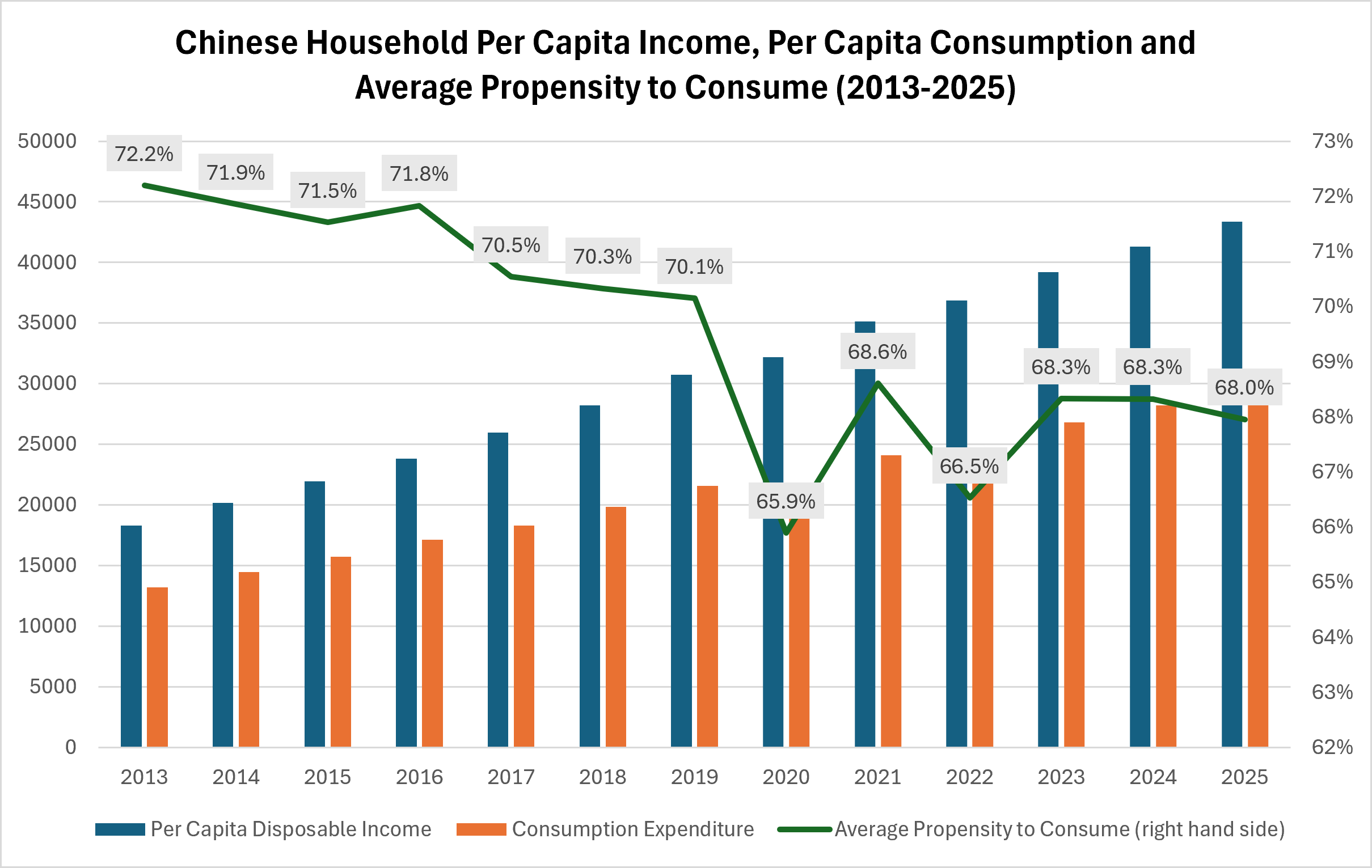
The pandemic broke the gradual downward trend with a sharp dip downward, and although consumption has since recovered somewhat, the ratio remains below its pre-pandemic level. This is the great puzzle. Why?
Well, it depends what you think the disease is.
Can’t Spend What You Don’t Have?
If we start by treating consumption as the issue to be addressed, we will immediately find candidate answers. Let’s start with the common claim that Chinese household consumption is low because households lack the income to consume. In other words, let’s put aside willingness to consume, and look more closely at capacity first.
Well, there IS logic to the idea that some cohorts don’t consume because they don’t have enough income flow to spend. This clearly applies to lower-quintile households with little or no disposable income, of which there are many in China.3 Additional income for these households would very likely translate into higher consumption.4 But whether that would materially change the national consumption picture is a separate question.
Chinese consumers today spend slightly less of their income on current consumption than they did in years past, despite seeing income growth several times over in recent decades and enjoying continuously strengthening purchasing power along the way.5
Between 2021 and 2025 specifically, China’s per-capita disposable income rose from RMB 35,000 to more than RMB 43,000.6 Remember how I started this essay by talking about that additional RMB 7 trillion in new bank deposits over the first eight months of 2026? Turns out it’s absolutely dwarfed by the accumulated deposits of the five years prior. Over 2021-2025, households accumulated an estimated RMB 73.3 trillion in new bank deposits, at an average volume nearly 2x higher than over 2016-2020 .7
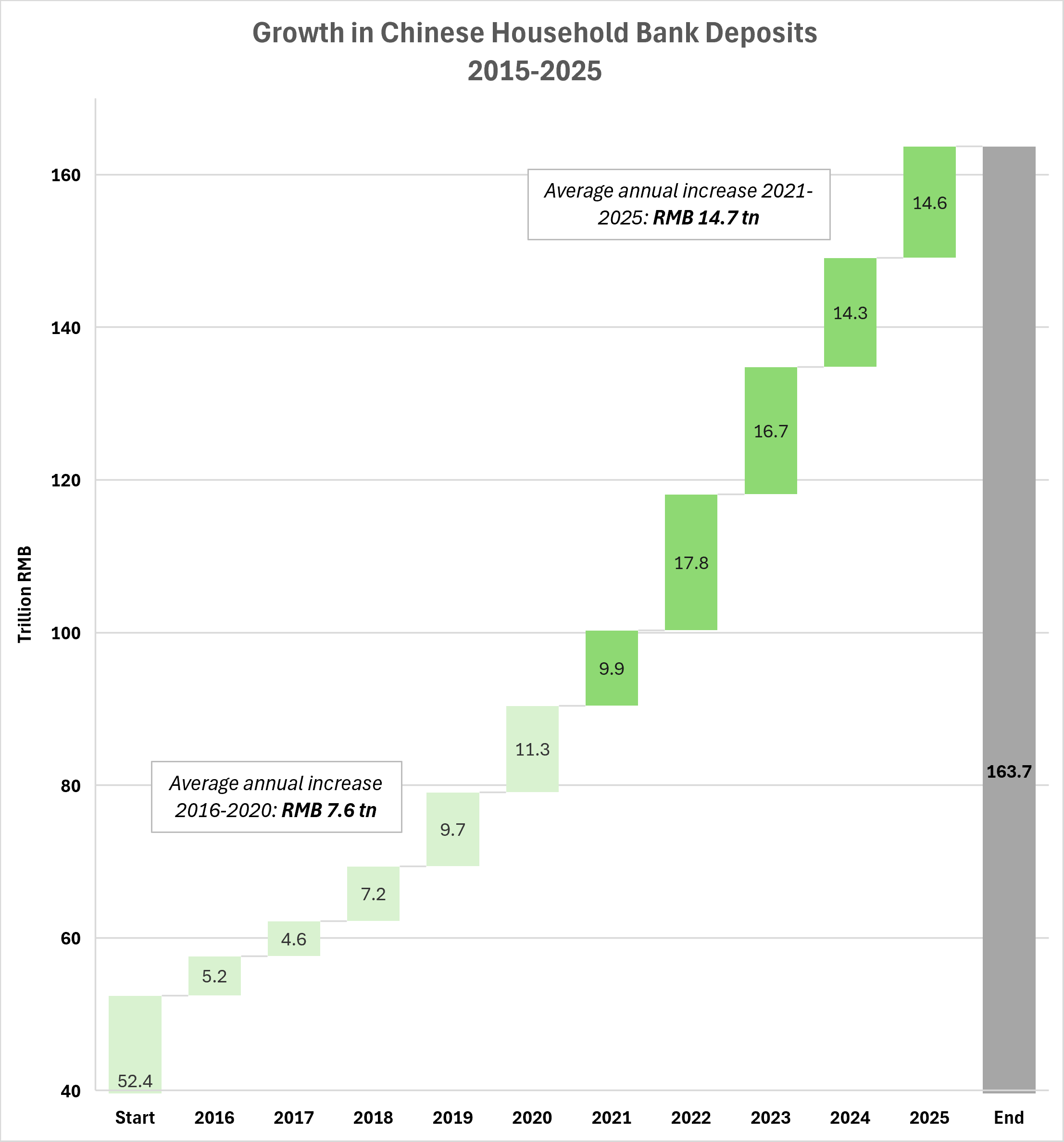
This is a big problem for the insufficient income argument. If weak aggregate consumption were truly primarily a function of broadly insufficient incomes, then income growth together with modest or flat CPI growth would be accompanied by a rising share of income devoted to consumption, not a massive accumulation of deposits. But that’s not happening.
We need to keep looking.
Well Duh, it’s the Social Safety Net?
This is the point where someone would surely say: “okay, but what about the China’s weak social safety net?”
This is a familiar argument, of course. As the narrative goes, Chinese households consume less because weak pensions, healthcare provision or other gaps in the social safety net force them to allocate more to savings to prepare for rainy days. At this point, it’s almost the default explanation for why they are unwilling to consume, even when they clearly have the capacity to. This has essentially been the IMF’s position for the last 15+ years, and plenty of domestic Chinese commentators have made the same case.
Like the income item, social welfare surely plays some role, particularly for vulnerable households. But again, this explanation can only take us so far.
The main problem is that household consumption rates have declined over the last decade, while China’s social welfare system has seen significant expansion over that period, including major upgrades to pension coverage and healthcare outlays. If weak consumption were primarily driven by inadequate welfare provision, we would expect at least some corresponding improvement in consumption behavior as those systems improved. Yet the consumption share remained low during this period - and even fell.
Indeed, recent critiques have already made similar observations, arguing that the weakness of China’s social safety net has often been overstated in foreign commentary and given too much explanatory weight in discussions of household consumption8
Also, the households accumulating tens of trillions of RMB in additional deposits are generally not going to be the households whose consumption decisions are constrained by welfare provision.9 This distinction is important, because it means whatever “missing consumption” might be unlocked by welfare transfers to low-income groups belongs to a different and much smaller bucket10 than the “missing consumption” associated with higher-income households squatting on their growing Himalayan-sized mountain of deposits. We are more concerned with the latter.
And so the puzzle remains. Chinese households continue to direct a growing share of additional resources away from current consumption, even as incomes, purchasing power, and social welfare provision have improved. Why? Any convincing account of household behavior must explain this allocation pattern.
It’s a Balancing (Sheet) Act
Up to this point, we’ve been asking whether Chinese households lack confidence because of weak income growth or weak welfare. Both explanations basically focus on income flows, in and out. But households can do more with income than consume it.
On the household level, income not consumed does not disappear into an abstract bucket called “savings”, even if that’s how some macroeconomists are fond of imagining it. Individual, real households allocate it somewhere, for some purpose, with some expectation of what it will become. The portion that is not consumed becomes accumulated wealth.
Unlike the American household, whose wealth is diversified across a wide range of assets including securities, retirement accounts, and property, Chinese household wealth has for decades been concentrated primarily into just one asset: property. Chinese household confidence is strongly influenced by the perceived value of that accumulated wealth. By extension, a major (perhaps even the major) determinant of Chinese household confidence is the direction of property values.11
But although the source of Chinese household confidence is far more concentrated than for American households, confidence manifests in importantly similar ways across both countries: Households that feel confident are more willing to spend money and borrow against the future; conversely, when their confidence falters, they become more cautious, defer consumption, and focus on repairing balance sheets.
Of course what they are willing to spend on and borrow for again becomes a point of divergence. American households use debt for lots of things, but notably are famously willing to express their confidence via consumer leverage, borrowing against future earnings to support current consumption. Chinese households, by contrast, are far less inclined to take on debt for consumer purchases of things like vehicles or refrigerators. After all, if Chinese households are already reticent to spend today’s money on consumption today, they certainly aren’t going to spend tomorrow’s money on consumption today.
Historically, there has been just one major exception to Chinese households’ general reluctance to spend against future earning. And it’s the key to everything in this essay.
Property, Again.
That’s right. The asset that generated Chinese household confidence was also the only thing households were consistently willing to borrow against future income to acquire more of today. Despite their broader aversion to consumer debt, for decades, millions of households willingly signed up for thirty year mortgages, concentrated the bulk of household wealth in real estate, and treated future housing appreciation as a central pillar of financial planning. We can quibble over whether residential property is actually investment or consumption, but that’s a distraction in this case. Before 2021, that’s where as much as 80% of household income not allocated to current consumption went.12 Not accumulating as rainy-day bank deposits or other liquid assets, but in property - one of the most illiquid assets of all.
That’s not to say wagering so much on the performance of a single asset class was irrational or unreasonable. Actually, you would have been foolish to store household wealth in literally any other asset, because for those decades, it was hardly a wager at all. In other countries, household wealth is spread across a mixture of assets because they offer diversification without necessarily sacrificing returns. In China, nothing appreciated as rapidly or as consistently as property, and households allocating their investment yuan anywhere else were leaving money on the table.
Property wasn’t merely competing with other financial assets as a destination for household savings. It was competing directly with current consumption. Every vacation postponed, every restaurant meal skipped, every discretionary purchase forgone could instead become part of a down payment or additional home equity. Every yuan spent on current consumption implied the sacrifice of several yuan that would be eventually realized (sometimes very rapidly) as home equity gains.
Finally, consumption was not merely competing against the financial return on an apartment. It was competing against everything that apartment represented. For generations of Chinese households, homeownership had been inseparable from definitions of family success and expectations around intergenerational responsibility. It was a prerequisite for marriage and family formation, a source of social status, a route to better urban schools, and a store of wealth, ensuring an inheritance for the next generation. Delaying consumption to divert income to property acquisition was not just an sound financial choice; it also satisfied a powerful social obligation.13
And yes, property acquisition also provided a degree of old-age financial security in an economy where pensions remain thin for many households, especially in rural areas. The desire to accumulate wealth has many drivers. Concerns about retirement security, healthcare costs, family obligations and other welfare uncertainties surely contributed. But following the previous few paragraphs, I hope it’s legible why welfare-centric explanations shouldn’t have the starring role they have been assigned in so much commentary on the Chinese macroeconomy over the last two decades.
Those explanations treated weak consumption as the central phenomenon requiring explanation, and precautionary savings as the mechanism behind it. But weak willingness to consume was just one side of the ledger. The more salient phenomenon was the incredible willingness of Chinese households to direct resources into property acquisition. It was an investment, a status symbol, a marriage prerequisite, a route to better schools, a vehicle for intergenerational wealth transfer, and a source of old-age security. Consumption was downstream of investment, not the other way around.14 Reducing this phenomenon primarily to a story about precautionary motives misses most of the point.

Of course, the great enabler of this phenomenon was that apartments were assets with values that seemingly could only appreciate. Property price growth might pause here and there, but it never really went down. Heck, in 2014-15, the property market was actually quite soft amidst oversupply and a brief retreat of speculative demand, and what did Beijing do that time? It cut rates, eased restrictions, reduced down payment requirements, and revived the sector to boom for five more years.15
So “property always goes up” was a mental model that survived and flourished, partially because prices had indeed almost never fallen, but also because Beijing had established a precedent that property would be rescued if it ever started to look weak. So then property appreciation in many people’s eyes was just a matter of national policy. Everyone seemed to agree that it had become too deeply embedded in China’s growth, finance, local government revenues, and the household confidence model itself for Beijing to tolerate a collapse, no matter how much of a bubble it walked and quacked like.
And so Chinese households that would never finance a vehicle purchase or a family holiday on a credit card would eagerly line up to take on decades of mortgage payments. They weren’t comfortable with consumption debt, but buying property was not consumption anyway. It was sound, responsible investment, an anchor of stability, and the ultimate fulfilment of the social contract owed to your family, both the generations preceding you and those not yet born.
This belief was the machine that turned today’s income into tomorrow’s wealth, and tomorrow’s wealth into today’s confidence.
Until it broke.
Houses are For Living
For years, Beijing had watched property become not only the dominant store of household wealth, but the dominant destination for almost all household income not consumed. Its policy choices encouraged this model, and the outcomes enjoyed by households sustained it. The more property generated wealth and confidence, the more dependent households, local governments, developers, and lenders became on its appreciation.
But the same mechanism that generated rising confidence, wealth, and urban homeownership was also generating speculation and housing unaffordability. While consumer goods and services remained highly affordable relative to wages, most of the inflation from the property boom years was being absorbed into housing and land values, which steadily rose, far more rapidly than incomes. It was a consumer’s paradise - unless you were trying to buy a place to live.
The same property wealth mechanism that generated confidence for homeowners generated anxiety for would-be homeowners unlucky enough to enter the market later in the boom cycle. Every month they waited, the minimum down payment was further out of reach. Every month they delayed purchase, housing appreciation further outpaced wage growth. This helps explain why rising incomes through the 2010s did not necessarily become discretionary spending; they simply became proportionally-larger down payments, with household allocation to consumption continuing to fall. By 2020, a typical Shanghai home cost roughly 30x annual income. Nationally, the multiplier was lower, but still in the 9-10x range. For many households, accumulating even the minimum down payment required years of disciplined saving, plus a huge contribution from family members.
So, while someone who already owned an urban home happily levered up for their second and third apartments and consumed to their heart’s content, the first-time buyer could hardly even dream of discretionary spending. People already inside the housing system were becoming wealthier and more confident, while those still trying to enter it were becoming poorer every day, relatively speaking, looking for ways to consume even less to hasten the arrive of the day they could buy property. At the same time, households, developers, local governments, and the broader economy were becoming increasingly dependent on the assumption that property values would continue rising indefinitely. There was a stunning amount of debt, economic activity, and financial confidence all riding on that assumption.
And Beijing knew it. Following the policy-backed bailout of the 2014-15 property sector weakness, a new national slogan formed, introduced in a December 2016 Xi speech at the annual meeting of the Central Economic Work Conference:
“houses are for living, not speculating”
At the time, it would have been easy to dismiss the phrase as political boilerplate. After all, policymakers had intervened just last year to stabilize the sector when it had last gotten into trouble.
With the clarity of hindsight, this was more than banal fretting about a property-segment bubble. Beijing may not yet have foreseen every consequence of what it had built, but it could at least see the confidence machine was developing a serious pathology, and speculation was a symptom. Homes were increasingly beyond the reach of first-time buyers. More household income was being pulled into down payments and mortgages than ever. More banks, developers and local governments were terminally dependent on permanently-rising property values. And because so much household wealth was stored in property, the machine increasingly required on prices rising just to sustain the confidence it had created.
The disease on the macro level was an economy that was becoming dependent on the machine continuing to run forever. Someone would have to do something about it. But what? And who? And when?
Someone Does Something About It
The popular memory of China’s property downturn often begins with Evergrande’s spectacular collapse in Q2-3 2021. Or perhaps when average property prices across most major cities began falling (September 2021). But those events were both downstream of Beijing’s Three Red Lines policy in August 2020. I will not rehash the TRL here; you may go read a summary on someone else’s website.16 It is sufficient to say that this policy’s key outcome was the denial of additional credit to China’s most heavily indebted property developers. Importantly, at that point it was not explicitly about controlling housing affordability - just developer debt.
Of course, policymakers weren’t oblivious to the likelihood that this would put downward pressure on property prices. Denying credit to indebted developers who were previously relying on a “borrow-to-build” model would force them to sell existing inventory at lower prices to raise cash instead. In September 2020, just one month after the TRL were announced, Chen Xiao of Zhuge Findata was quoted on China National Radio saying “under the pressure of the ‘three red lines’, and performance targets, many developers will likely use prices to exchange for volume (以价换量) to rapidly recover funds….in the fourth quarter, housing prices may have room to decline.”17 Similarly in December 2020, Li Peijia of the Bank of China Research Institute noted “under the background of tightening real estate financing policy, one of the developers’ coping strategies will be to accelerate sales and use prices to exchange for volume to recover funds, which will help stabilize real estate prices”.18
Now, did these policy-adjacent analysts foresee the second-order impact on household confidence and the profound implications for property prices and everything else downstream of household confidence? I wouldn’t say so. They were using language about “stabilization” and “healthy long-term development” and “moderate correction”, not deflation and confidence collapse. Not yet.
But by Q3 2021, over 300 developers had gone bankrupt over the first nine months of that year - more than one per day. Land sales were down more than 11% YoY. Inventories were piling up. Importantly, large developer insolvencies like Evergrande were shifting the narrative for property buyers from price risk to delivery risk. Perhaps the only thing worse than “the asset I bought is no longer appreciating” is “the asset I bought may never even exist at all”.
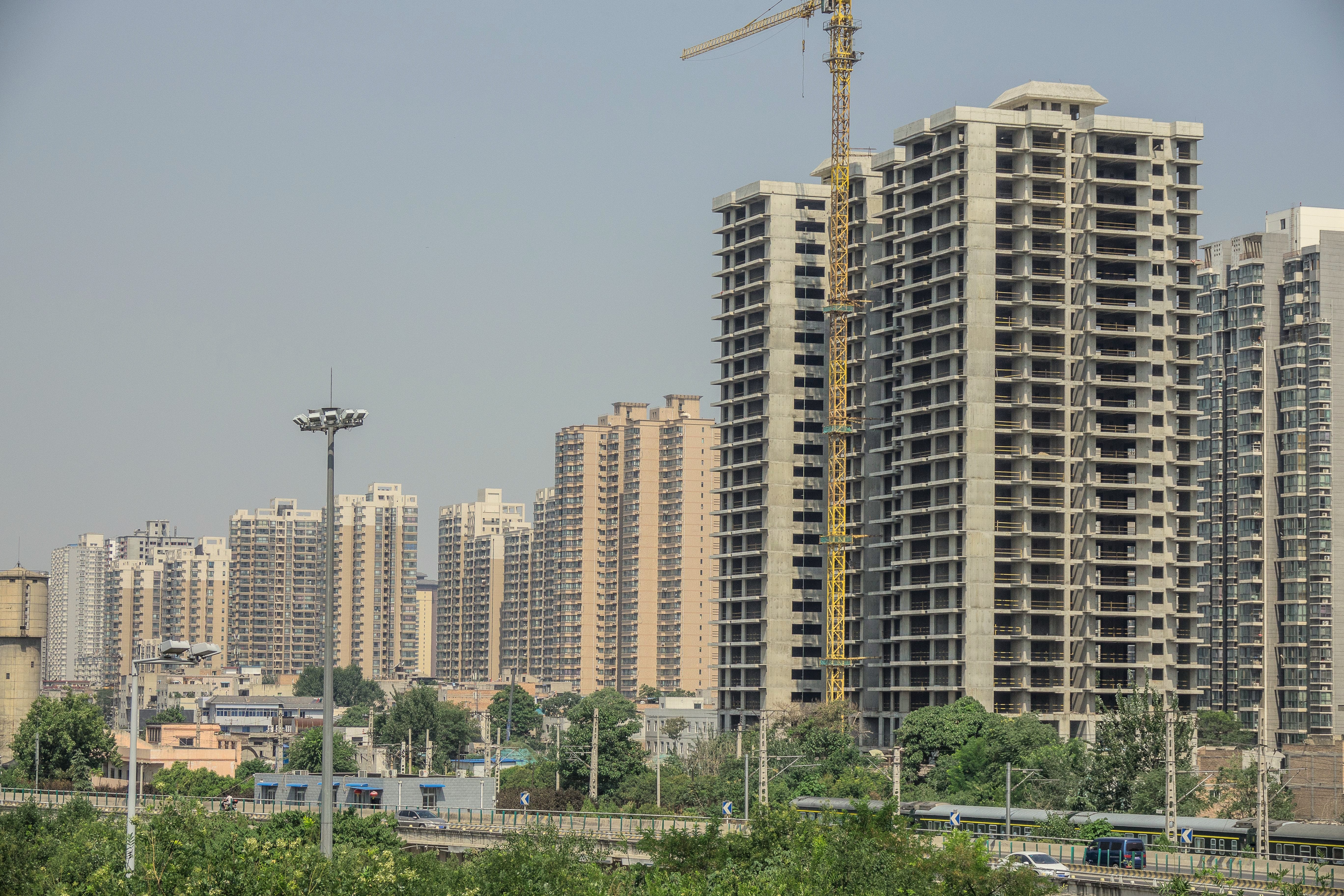
Buyers who had watched the 2015 bailout and ignored the 2016 “houses are for living” slogan suddenly realized that the old confidence machine was being dismantled. Confidence rarely disappears all at once, but the sentiment bust timeline over 2021 was remarkably compressed. Price growth slowed. Then appreciation of any kind became uncertain. Suddenly, the impossible became possible. Prices were falling. Developers were failing. And Beijing was tolerating it.
Then the second-order negative feedback loop began: lower prices produced lower confidence, which produced weaker demand and still lower prices. This was the part of the equation that Beijing’s macro analysts had perhaps underestimated. The dramatic mismatch between urban housing supply and end-user demand was laid bare. With the speculative demand spigot turned off, market prices started spiraling towards a new equilibrium, a bottom they continue to seek today.
But of course the consequences extended beyond the property market. Property was the principal channel through which Chinese households accumulated wealth and generated confidence. When the market turned, the confidence machine turned with it. Existing homeowners felt poorer and consumed more cautiously. Households still looking to buy their first urban property became more inclined to wait. With the attractiveness of the property allocation channel deteriorating, an awful lot of yuan that used to go directly into property - or into deposits and then property, is now stuck in deposit limbo. Tens of trillions of it.
This also highlights one of the ironies of China’s consumption woes today. During the boom years, current consumption’s share of household budgets was low because households were putting as much of their marginal yuan as possible into property. Following the bust, the share of current consumption has gotten even worse. Households no longer trust property, but also lack a more convincing alternative, so they’ve started leaving it in the bank. The old allocation rules were broken, but nothing has replaced them.
Whatever role market forces eventually played, the fundamental decision to constrain the old property confidence machine - and its timing - was not made by investors. It was made by policymakers. Some may believe it was coincidental that announcing the Three Red Lines during Covid had the effect of obscuring how much of the subsequent economic damage was policy-induced. I do not. They knew the treatment would hurt. Covid has made it difficult for many observers to separate the effects of policy from the effects of the pandemic itself. From my extensive taxi driver interviews, I can tell you that “the property market went bad because of the pandemic” remains a very common sentiment.
That being said, it would be too generous to claim that Beijing saw this far ahead, to where we stand today. Too many moving parts, too many second- and third-order effects. But they picked a direction and now they are committed to it. As the proverb goes, once you’re riding the tiger, it’s awfully hard to get off (骑虎难下). And so what began as an exercise in debt discipline has now become an exercise in broader economic restructuring. One uncertain step at a time. Crossing the river by feeling the stones, so to speak.
Hey, That’s the Name of the Blog
By now, I hope I have established that the disease Beijing believes it’s trying to treat is not weak consumption itself. It is the property-centric confidence machine that had become symbiotically embedded in household balance sheets, developer business models, local government revenues, and the broader economy. Low propensity to consume was just a symptom - the inverse of high propensity to allocate to the property market. For decades, Chinese households had internalized a simple lesson, and policymakers reinforced it: income should become property. Today, Beijing is clearly telling its citizens: no, not like that anymore.
Changing the entire logic of the Chinese household income allocation regime is a massive task. For a long time, the confidence machine conveniently told households both where to put their marginal yuan and why they should feel good about it. The first step in the treatment plan was dismantling the machine, to the dismay and horror of financial analysts, and at considerable cost to buyers who entered the market at the top of the cycle. Now, households need both a new destination for that marginal yuan and a new reason to feel good about where it ends up.
But rebuilding confidence without recreating the conditions that produced the disease in the first place will be very difficult. If housing is for living, not speculation, then what does Beijing think can replace property as the source of household confidence? And where exactly does the government want households to put that marginal yuan instead? Securities? Pensions? Consumption itself? Until a convincing alternative emerges, the answer is probably going to remain what it has been for the last few years: bank deposits.
Surely Beijing has a plan, right?
Well, that’s where the story gets really interesting…
Part 2: Is Beijing Stupid or Something? (WIP)
If you don’t want to miss the next one, consider dropping me a sub. It’s free, and you can always change your mind later.
This specific formulation is intentional. I have intentionally avoided calling the non-consumed portion “Savings” although that’s how it’s usually bucketed in macro accounting identities. Historically, very little of this non-consumed portion accumulated as liquid deposits, until the economy changed in a big way, as we shall see later.
The series begins in 2013, when the National Bureau of Statistics adopted a unified household survey methodology covering both urban and rural residents. Earlier data were compiled using separate urban and rural surveys and are therefore not directly comparable.
In 2025, the bottom income quintile as defined by China’s national statistics bureau had average per capita disposable income of just RMB 10,150 per year. This is per capita disposable income across a cohort of 280m people, not earnings, wages, or household income, and I am very sensitive to the difference, but many are not, so I’m hiding it here in the footnotes where it will only be seen by detail-oriented people, rather than putting up in the main essay where it may easily be misinterpreted. For broader commentary on how this data series is often misinterpreted, see this piece.
The high propensity of low-income groups in China to convert additional income to consumption has been covered by a lot of research, for example: https://wenku.baidu.com/view/58719ccc41323968011ca300a6c30c225801f0d5
Income growth has outpaced CPI inflation in most years, even after accounting for accounting oddities like imputed rent.
Income growth has not been uniform. It has certainly been weak/negative in property itself and property-adjacent sectors like construction, building materials and property services. It has also been flat in many local government and SOE segments, especially in smaller cities where local finances have been hit by the collapse in land sales. But those areas of weakness have not been large enough to offset gains elsewhere in the economy. Disposable incomes for households overall have continued to rise, even if some individual households have not experienced it.
It’s worth nothing that the household deposit growth rate is actually slowing quite substantially this year, based on the Jan-Aug data. https://finance.sina.com.cn/roll/2026-01-19/doc-inhhuvac8126827.shtml
For example: https://www.piie.com/publications/policy-briefs/2025/does-weak-social-safety-net-hold-back-private-consumption-china
No currently publicly-available dataset clearly lays out the allocation of the recent increase in household deposits across income groups. My statement here is based on household saving capacity by income group. Research based on the China Household Finance Survey published in 2020 found the highest-income 10% of households generated 63% of aggregate household savings, while almost all (91.5%) of households in the bottom 20% recorded negative savings. More recent survey evidence from 2023 found that increases in deposits were especially pronounced among high-income households. These results cannot identify who exactly owns the deposits accumulated since 2021, but strongly suggest they have been generated by households with substantial surplus income.
Even aggressive proposals for consumption stimulus or direct transfers are measured in hundreds of billions or a few trillion RMB, not the tens of trillions that have accumulated in additional household deposits since 2021.
This housing wealth = Chinese consumer confidence linkage is backed by many domestic and international surveys and studies. For instance:
https://www.mdpi.com/2073-445X/13/4/521;
https://www.bis.org/publications/working-paper-1319-housing-wealth-effects-china;
https://journals.plos.org/plosone/article?id=10.1371/journal.pone.0289712;
https://www.mckinsey.com.cn/%E6%96%B0%E5%B8%B8%E6%80%81%E4%B8%8B%E7%9A%84%E4%B8%AD%E5%9B%BD%E6%B6%88%E8%B4%B9/, and many more.
Flow-of-funds estimates from Huachuang Securities put residential property purchases at roughly 24% of household disposable income during 2017–2019. With a 70% current consumption rate (ergo 30% savings rate), that yields a rough estimate of ~80% of savings going to property acquisition during that period.
It’s relevant to point out here that Chinese homeownership rates are already very high. But the first and often only home for rural citizens is the self-constructed house in their village, not an urban commercial property. While the village house provides a fallback option, it’s typically not suitable for family advancement, getting married, getting kids into good schools, etc.
For a less abstract example, in my own household we are currently saving for a property purchase by first assigning a fixed amount each month to a housing fund and then allowing consumption from what remains. Without context, an accountant might observe my household balance sheet and conclude that we consume first and save the residual. The arithmetic is identical, after all. But the logic would be backwards. If you wanted my household to consume more, would your policy prescription be the same for both cases? You can look at aggregates all you want, but when it comes to policy, you have to ask: what are actual households trying to achieve?
For a contemporary discussion of the often-forgotten 2014-15 property downturn, including the weakening sales, falling prices, elevated inventories, and subsequent stabilization, I recommend reading the World Bank, China Economic Update issues from December 2014 and June 2015.
For example, https://english.ckgsb.edu.cn/knowledge/professor_analysis/series-chinas-real-estate-problem-1-the-three-red-lines/. While this summary does a good job explaining the property sector bubble and the Three Red Lines, it glosses over the sociocultural role property plays for Chinese households. It focuses on the need to stabilize property prices, but treats that as an exogenous issue, rather than a symptom of the property-confidence machine I discuss in this essay.
https://finance.cnr.cn/gundong/20200915/t20200915_525254490.shtml
https://www.peopleapp.com/rmharticle/30020607395
Great article! Great explanation beyond the simple narrative we hear too often
nice one. looking forward to part 2.