
This essay was first posted as a thread on Twitter on April 19, 2025. It has been edited lightly for essay format.
I'm heading to a meeting in Pudong (the other side of the river in Shanghai). Mrs. Mi picks me up in a new GAC Aion Y and confirms my phone number.
Her Chinese accent sounds like mine in Chinese class 15 years ago. Mandarin is clearly not her first language.
"You...you're not Chinese, right?" she asks.
"No, I'm American. Do I look Chinese?"
"You look Arabic, or like you’re from Afghanistan. But you sound Chinese"
"I've been here a long time"
"How long?"
"13 years"
"Oh, longer than me"
"How long have you been in Shanghai?"
"Over one year"
"Ah, welcome to Shanghai. I can hear your accent...you're from Xinjiang right? What part?"
"Yes. I'm from Kashgar"
"Oh, Southern Xinjiang. I have friends from Korla and Yili, but I don't know anyone from that far south."
"Yes, that's Northern Xinjiang. Different from us."
"Do you drive Didi full-time?"
"Yes, this is my full-time job"
"So I guess you drive all day? 14 hours?"
"Normally 15 hours. I drive in the morning, rest for 2 hours, then drive again in the evening"
"That's very tiring. But you should make good money"
"Not bad, about 700 yuan a day"
"How many days do you rest each month?"
"Just one..."
"Wow, so you're making ...700 yuan times 30 days... Then subtract the lease for the car...which is what...like 7k a month...?"
"It’s a little over 20,000 a month. I don't rent this car...we bought it. So I have to pay back the car loan."
"Ohhh...you bought the car. Are you by yourself in Shanghai?"
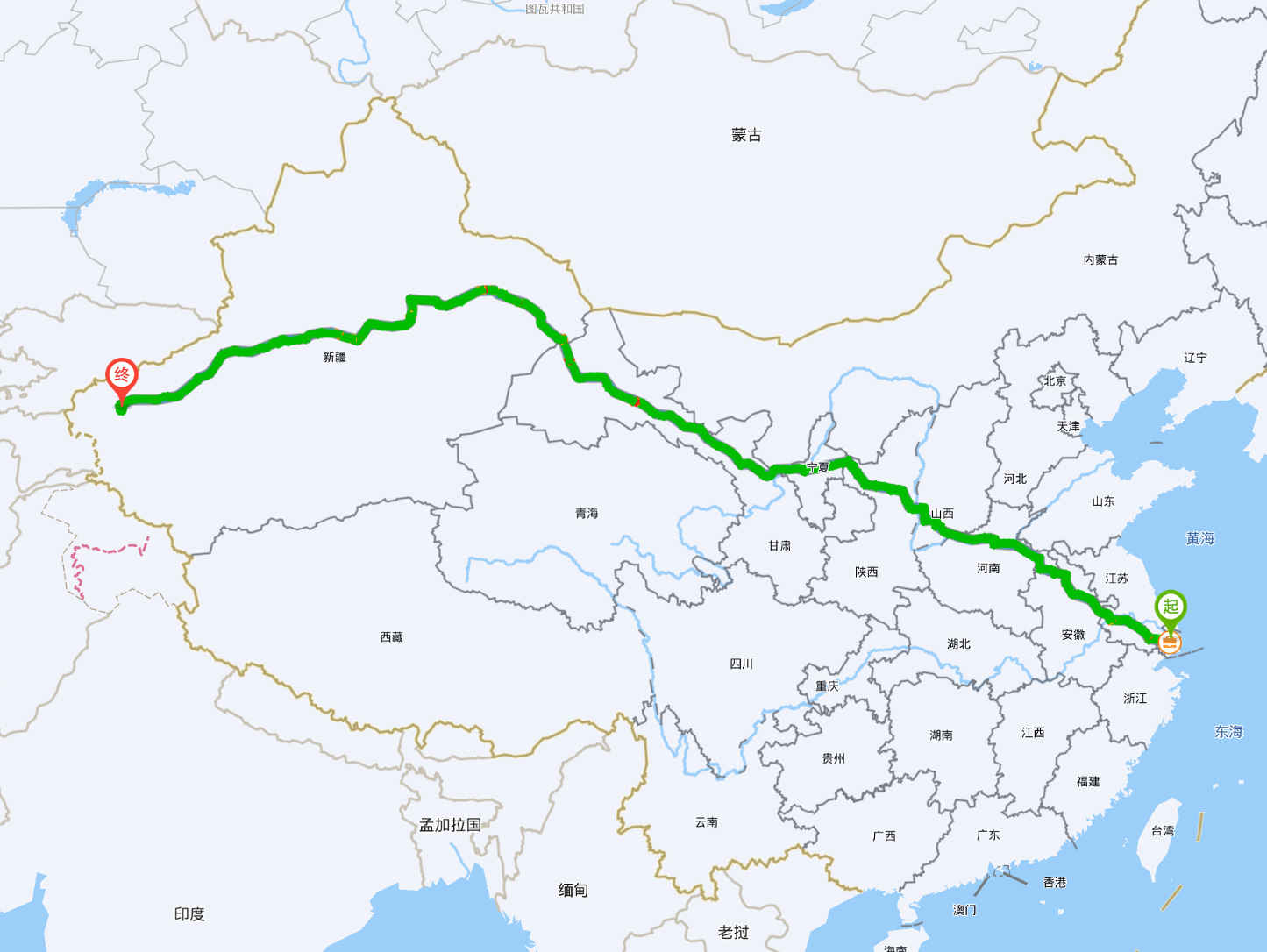
"No, my husband is here with me. We are both driving. We drove here together from Kashgar to make money in Shanghai.”
"Does he also drive 15 hours a day?"
"No, less, because he has to share his car with another guy. So he only drives for half the day"
(She's grossing about 2x the median Shanghai salary, and about 3-4x a typical F&B salary, e.g. a server in a restaurant)
"So the two of you are making several tens of thousands a month. What is the plan? Go back to buy a home?"
"Yes, we will go back to Kashgar to buy an apartment. Our child is there now, with my parents. We don't want him to grow up without his parents, so we will go back to buy a house in Kashgar."
"How much is real estate there?"
"For one square meter...you can find houses for 3000, 4000, 5000 RMB. You can get a house for 100k, 200k, 300k RMB total. We plan to buy a 70sqm house for 300k. How much is that per square meter?"
I input the numbers on my phone. "That's 4.2k RMB per sqm. That's pretty cheap. I guess you'll be able to go back soon"
"Yes, we'll go back before the end of the year"
"It would take a long time to save up for this if you worked in Kashgar?"
"Kashgar...the jobs are bad. The most I could make in one month is 3000. And my husband could make 4000 or 5000. Too little."
"So it makes sense to come here, work like this two years, then go back. But it's a burden."
"Yes, it's a burden for us, for our child, for my parents. It's hard for everyone" (大家都辛苦了呗)
Now she wants to ask me questions.
"Are you really American? You don't look American. You don't have blonde hair..."
"Not all Americans have blonde hair. Actually most of them don't. There are all kinds of Americans."
"But in the movies they have blonde hair."
"Do all Chinese people look like Chinese actors? Of course not. American people don't look like American actors either"
She's not convinced. "You don't look American. You look like...you look like one of ours..."
"From Xinjiang?"
"Yes, you look like some of our people from Xinjiang"
"haha, some Chinese people told me that before, but I don't see it. My ethnic background is closer to Mediterranean. Italian and Jewish. You think people in Xinjiang would believe I'm from there?
"Yes, they would"
"Well, I don't speak any Uyghur, so they would know right away I'm not. I only know one phrase: "qoy shish kawap, pish dey?" Can you understand me? I probably said it wrong..."
"It means 'are the lamb skewers ready?'"
"Yeah, haha. A Uyghur guy at the BBQ restaurant I used to go to taught me how to say this. Is the Xinjiang food in Shanghai good, in your opinion?"
"It's okay. There are some good restaurants."
"Would you consider them authentic?"
"Not bad. You can try one in Shanghai, it's called Baigelige. I think it's good. We go there with friends."
"Are there many people from Xinjiang like you, working in Shanghai to save money and go back to buy a house."
"Yes, a lot. I know they are here to make money. But I don't know their destination...to buy a house or something else."
(amusingly but endearingly, she uses the wrong Mandarin word here, mixing up the words for "objective" and "destination", which is something I did too for years)
Is there Xinjiang food in America?"
"Yes, I think so, in some big cities. I've heard you can find Xinjiang food in cities like New York. But I've never tried it."
"Do Americans eat pork?"
"Yes, mostly. Unless they are Jewish or Muslim"
"Oh, there are Muslim people in the USA?"
"Yes, many. There is every kind of person in the USA"
"What do you eat in Shanghai? Is there authentic American food? Have you adapted to eating Han food?"
"There are some good American-style restaurants. But I eat everything...Western food and Chinese food..."
"Oh, okay..."
We're nearing my destination, so I pull open the Didi app to check her name.
"Okay thanks for the ride, Mi Shifu. Eh...your surname is Mi? Like rice? I guess that's not your whole name"
"No, we have longer names. I choose a shorter name so it's more convenient. Mi is just the first part. My whole surname sounds like "Mi Ya Gu Li" (米娅古力)."
"Oh, I understand. I have this problem too. My surname in English is too inconvenient to say in Chinese so I shorten it. Okay, thanks Miyaguli Shifu. Bye!"
"Bye!"
The content of the conversation wasn't so different compared to conversations I've had many times before in taxis and rideshares in Shanghai. Regardless from where people come, be it Anhui, Henan, Dongbei, or Xinjiang, they generally plan to bust their ass for a few years in Shanghai, working as hard as their bodies can endure, and then go back to their hometowns to slow down and buy property. That’s the modern pathway to fast-tracking first home ownership these days. I have a lot of taxi conversations that are just repetitions of that same theme, so many I don't bother sharing anymore, because it would just be the same story.
What made this time notable was my driver was a Uyghur woman from Kashgar. Female taxi drivers are already pretty uncommon in Shanghai (not sure why, because they're common in Beijing) and migrant female taxi drivers even more uncommon. Thinking back, this might even be my first time. In the few times I had a female driver in Shanghai in the past, it was always a Shanghai local, driving part-time.
Her Mandarin was pretty choppy and it was apparent that she wasn't super comfortable with it. The basic chatting we were doing was probably just about her limit. She was late 20s if I had to guess, and I suspect she barely spoke Mandarin before she got to Shanghai (that's been the case for my other friends with similar backgrounds).
Anyway, I wish her the best. I’m finally posting this essay on my Substack nearly a year after I met Mrs. Mi in Shanghai. I hope she’s not in this city anymore. I hope she executed her plan on schedule, and she’s back in Kashgar, where she’s already bought her apartment with her husband and they’re raising their little boy or girl and not thinking anymore about those 15-hour days driving a car in Shanghai.
If you want to visit the Uyghur restaurant in Shanghai that she thinks is worthy of being called "pretty good", it's this one: 百格里格 Kashgar Flavor. After she recommended it so heartily, I had to try it, but I thought it was just okay myself. But what do I know? Although a lot of people think I could pass for it, I’m NOT actually from Xinjiang. :)
Thanks for this conversation! Fingers crossed she and her husband have accomplished their financial goals and made it back to their little one. I bet it’s so hard for the kids of all migrant workers to be so far from their parents.
Curious, what are your friends’ backgrounds from Korla and Yili? (I’m assuming those are the friends that weren’t using Mandarin until they were in Shanghai?) Cause those cities are a lot more ethnically diverse than Kashgar right?
Thanks for sharing this story, David!
After my recent trip to Shanghai (November of last year), I thought about sharing the stories told by my Didi drivers but never put into action. Maybe this is a nudge 😉, but will have to wait until I am back from Yunnan next month.
Kashgar, where two of my aunts went (my uncle, to Shihezi) in the 1960s, as 支边青年; a place I wish I had visited while they were still alive …