
Foreword: Today is a departure from my regular China social ethnographic content. If you’re only subscribed for taxicab interviews and China travel content, just sit tight; more of that will be coming in good time. But today, I’m going to write about the other thing this site is about: development. That’s, after all, what drove my interest in the energy sector in the first place, and what remains a key motivator for my professional endeavors today.
Introduction
Over the first half of 2026, a new phrase has inserted itself into the vocabulary of trade economists, policymakers, and journalists: “China Shock 2.0”.1 What began as a niche label for China’s dominance in electric vehicles, batteries, and other advanced manufactured goods has now evolved into a broader debate about development, industrialization and trade. Critics of China’s export dominance are naturally worried about the implications for what remains of manufacturing in the industrialized (or increasingly post-industrial) West. But an increasingly prominent version of this argument raises a different concern: that China’s rise is also closing the path that earlier generations of developing countries used to industrialize.
Versions of this argument are now appearing across policy journals and newspaper columns. A recent Foreign Affairs article, “China Is Pulling Up the Ladder Behind It: How Beijing’s Export Strategy Will Keep Poor Countries Poor”, summarizes the authors’ recent working paper at PIIE and presents perhaps the most forceful expression of the argument: By remaining active in lower value-added production (even as it upgrades to high-end manufacturing), China is crowding out poorer countries and closing the traditional export-led pathway to industrialization.2
This Foreign Affairs article is useful not because it is unique, but because it concentrates many of the central assumptions around this narrative into a single, clear thesis. Accordingly, I will use the article as a reference point throughout this essay. The real subject, however, is the broader line of reasoning that has become increasingly common in discussions of “China Shock 2.0.” and its effect on developing economies.
I do not claim China’s economic model poses no challenges for poorer nations. China is a continent-sized economy operating under a single trade, fiscal, and monetary regime designed primarily around China’s own development objectives. Its sheer scale allows it to sustain advantages across an unusually wide range of sectors at once. For countries hoping to build export industries of their own, that reality can be daunting.
My disagreement lies elsewhere: not with the idea that China is a formidable competitor, but with the claim that this amounts to “pulling up the ladder” according to some general theory of how development works. It relies on assumptions that do not hold up to closer scrutiny and treats the interests of a relatively small number of manufacturing competitors as though they were synonymous with the interests of the entire developing world. Ultimately, this thesis relies less on any real-world model of industrialization, and more on a tidy moral narrative of victims and oppressors. Once the actual mechanics of development are examined, and once we ask who really benefits from the proposed remedies, the argument is just not very convincing.
China is Not a Monolith
The first thing the China Shock argument often misunderstands is typically reflected in how China is described - like a single homogenous economic unit. When its proponents emphasize that China’s dominance of both high-end and low-end goods is unnatural, they want you to look at the high-tech industries of places like Hangzhou or Shenzhen and think: why is this country still making toys and t-shirts?
But in reality, it’s not Shanghai labor making cheap t-shirts. It’s low-skilled domestic migrant labor from rural or inland China, supported by mature industrial clusters. China is big enough and its internal development levels heterogeneous enough to specialize at multiple points in the value chain at the same time, the way different countries normally would. Call them China1, China2, China3 if you like. Together these different parts of China can cover a full spectrum of economic activities.
This confusion also prompts the frequent misuse of economic terms. For instance, at one point the authors of the Foreign Affairs article claim China seeks to “retain comparative advantage in everything” - a statement that has gone on to be repeated verbatim by many who agree with the thesis.
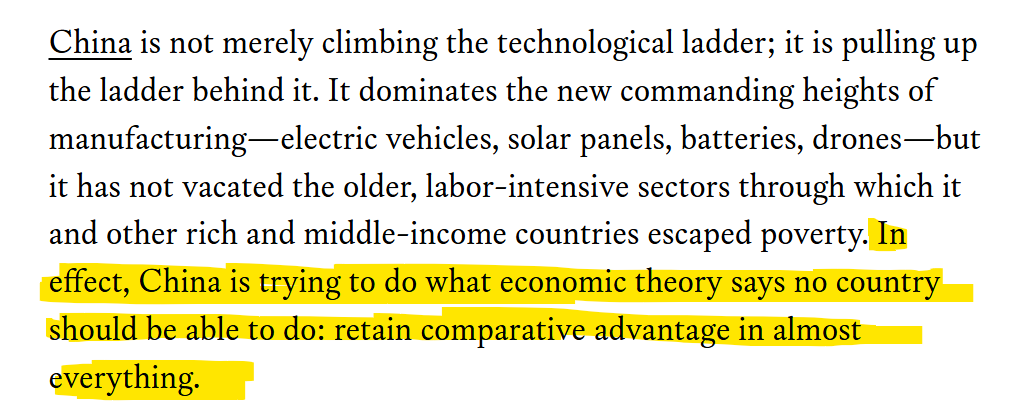
But that’s not how the concept works. Comparative advantage is about relative opportunity costs, not competitiveness. The authors seemed to be referring to absolute advantage across a wide range of industries, which is entirely possible. But that’s a different claim and invoking some violation of comparative advantage here only creates confusion. It still exists; it just determines which parts of China do what.
The ultimate claim that emerges is that the continued presence across so many sectors from so many Chinas crowds out poorer countries and blocks the traditional export manufacturing-led development path. If China collectively dominates not just final assembly but also all the steps of intermediate steps of value-add like fabric, buttons, packaging, logistics, etc., then it narrows the pathway for later-industrializing countries, who were “supposed” to inherit those segments. But is that true?
Development is Not a Queue
The argument seems to understand industrial development like a kind of queue: After one country vacates a space to produce a certain good, another country naturally advances into that space to produce that good instead. Each step forward represents an upgrade to industrial productivity and value-add. This is loosely reminiscent of the famous “flying geese” model for East Asia.3 But that framework is descriptive, not prescriptive. It can retroactively be applied to describe a historical pattern of industrial upgrading under specific conditions, but it does not form a general rule that industries must get handed over on a fixed timetable.
In reality, the ability to produce things doesn’t happen just because an empty space opens up in front of a country with low-cost labor. Countries still need infrastructure, logistics, supplier networks, reliable energy supply, sources of financing, and so on. In most cases, the key factor for whether a developing country can move to the space ahead is the maturity of their own production ecosystem, not whether another country is already occupying that space.4
Even if we look at more relatively mature late industrializers, where the “queue” model should theoretically be at its most prescriptive, the outcomes are hardly automatic. Take India for example. Examples abound of firms trying to shift production from China to India (particularly during the Covid pandemic) only to encounter meaningful constraints in supply networks or logistics that unwound the cost savings on labor.5 Most other late industrializers are even less prepared than India to absorb production displaced from China without substantial external intervention.
It’s Not Just About Labor
For this reason, metrics typically applied to measure whether a China has “excessive” low-end export dominance, such as its share of low-skilled exports vs its share of low-skilled labor, are flawed.6 This metric can only be used in that way if the rest of the production ecosystem is comparable across countries, and the only difference between India and China is their shares of low-cost labor. We already know it is not.
Anyone with experience across Asia supply chains could give you a long list of things that matter for China’s competitiveness other than its low-cost labor supply, including automation level, infrastructure depth, energy cost, logistics speed, supplier depth, etc. For Indian producers, Chinese intermediate inputs in particular have proved to be particularly difficult to eliminate. 7 One analysis even bluntly noted that even after years of targeted policy efforts, “dependence on Chinese technology, machinery, and upstream industrial inputs remained largely intact.”8
Today, China continues to account for a massive share of global manufacturing exports although its manufacturing wages are now as much as 5-10x those of India, Bangladesh, or Vietnam.9 However, a divergence between labor share and export share doesn’t automatically demonstrate distortion. It may simply reflect a productive ecosystem that is unusually efficient at turning labor into exports - the potency of which anyone who has sourced or produced products in China can attest to. Thus, treating labor share as the benchmark for when a country “ought” to give up certain industries is not especially helpful.
Historical comparisons of China today to the historical moment when more advanced economies gave up low-end manufacturing run into the same problem. Today’s global economy is not the global economy of years past, when the earlier industrializers underwent their productivity upgrades. Supply chains are deeper, logistics are cheaper, and production is more fragmented than in the past. Chinese production is now operating at a scale and level that has no precedents. It’s not clear that comparing to smaller, more homogenous economies that upgraded earlier would be very informative, or define when China ought to give up certain productive segments.
To their credit, the authors of the Foreign Affairs piece acknowledge in passing that China’s dominance may reflect real underlying competitiveness, not just state distortions. However, they then dismiss the scale of its contribution as “unknowable” due to incomplete Chinese data access, as if Chinese supply chains aren’t some of the most robustly studied production ecosystems in the world. That concession then disappears from the rest of their analysis and is absent in the conclusion. This is typical for the China Shock arguments generally, which focus on trade outcomes and market share while spending little time on the mechanics of industrialization itself.
Exchange Rates Can Only Explain So Much
The common argument here about exchange rates is somewhat more plausible and seemingly straightforward. If the yuan is undervalued, then it can act as a broad subsidy to exports. This has been one of the most consistent international complaints around Chinese trade policy, spanning from the time of the original China Shock to the current day, and it is certainly a logical place to look when trying to uncover why Chinese exports remain so competitive, despite constantly rising labor costs.
But even there, the FX argument can only explain the margins, not the whole phenomenon of Chinese productivity. A weaker yuan helps to bolster cost competitiveness but does not by itself explain how China built supplier networks, logistics systems, industrial clusters, or production ecosystems over decades. Put another way, the exchange rate may affect how much share China retains today, but it doesn’t explain how or why China is able to compete across so many segments of the value chain to begin with.
Whose Interests are Being Represented?
This discussion about the value of the yuan also highlights how the argument changes depending on whose perspective one adopts. We already know that for producers in wealthier nations with mature industrial ecosystems, the weaker yuan is a source of concern because it makes it harder to compete with Chinese exports. This was the basis of the concern around China Shock 1.0, and remains a motivation for China Shock 2.0, extended to the high-end segments China is now competing in.
But by contrast, developing countries are not solely competitors to Chinese industry; they are also importers of Chinese capital equipment like machine tools, power generation equipment, construction machinery, and so on.10 From their perspective, the same exchange rates that make Chinese finished goods harder to compete against also reduce the costs of their own industrialization. The benefits of a stronger yuan would accrue primarily to countries that are already competing with or close to capturing manufacturing activity from China, while the benefits of cheaper Chinese capital good exports are dispersed across a much wider set of developing economies.
This reveals how the “China is hurting the Global South” narrative is blending together concerns about competition and development, picking whichever hits harder in context. Once the focus shifts from consumers of Chinese capital goods to competitors of Chinese manufacturing, the interests of a few parts of the developing world may partially align with those of advanced industrial economies. But the remedies proposed will clearly have limited benefit for countries importing Chinese capital goods and industrial inputs. If the argument is about India, Bangladesh, Vietnam, and a few other countries directly competing for manufacturing activity, then reduced Chinese competitiveness looks quite attractive. But if the argument is about Nigeria, Ethiopia, or Bolivia, then cheaper machinery, infrastructure, and imported industrial inputs is perhaps the more attractive prospect.
What Is China Being Asked To Do?
We’ve now looked at three different commonly-cited indicators used to argue that China’s industrial dominance indicates unnatural distortion rather than real competitiveness. The first two (labor share comparisons and historical international benchmarks) are meant to show that China’s time in these sectors should have already passed. The third (the exchange rate) is meant to explain why is still hasn’t. But each of these arguments is built on a weak foundation: the first overemphasizes labor as the determining factor, the second relies on non-comparable historical benchmarks, and the third overstates the explanatory power of the exchange rate. None of them constitute a binding model for behavioral norms in trade and development.
Furthermore, once we begin asking which developing countries actually benefit from the remedies being proposed, the picture is considerably less clear than the “China versus the Global South” framing implies.
With both the empirical rationale and the claimed constituency fuzzy, what’s left is a set of normative claims about what China ought to do and why. This is where the argument really loses persuasiveness. The demands usually involve importing more low-end goods, giving developing countries duty-free access, subsidizing imports from poorer countries, encouraging Chinese firms to move production abroad, allowing currency appreciation, etc. These all share the same underlying logic: China should give up productive activity so a small roster of other countries can take it.
Won’t this hurt Chinese domestic interests? The authors barely engage with the question, instead skating past it in their Foreign Affairs piece with: “Such measures might have some negative consequences, mainly in hitting lower-skilled Chinese exports”. Okay…then what is the case for why China should do it? Why should Chinese policymakers heed the calls of foreign analysts who are implicitly optimizing for something other than China’s own welfare? The only answer seems to be a normative political one: responsible leadership requires facilitating the rise of others. In other words, China needs to demonstrate leadership through sacrifice.
But even if India, Bangladesh, or Vietnam genuinely benefit from weaker Chinese competitiveness, it's not clear why Chinese firms - or policymakers - would drive this shift if productivity is still high and there are pools of Chinese labor that can be productively employed in lower-skill sectors. If those workers weren't making garments or toys or doing basic assembly, they would not suddenly be making semiconductors. They'd be doing something with even lower productivity - or perhaps unemployed. Ceding those industries to other countries means giving up viable employment for low-skilled workers - a rerun of what happened to manufacturing sectors across the West in decades past. This is not a concern to be casually dismissed by calls for virtuous leadership via sacrifice. And it’s inappropriate to deem this “pulling up the ladder” when much of China is still on the ladder too.
This is an Unprecedented Model
But perhaps you consider the moral mandate to be a defensible argument in and of itself. If you believe that’s what great powers should do, and so China ought to take on a global leadership role that involves charitable transfers of productive capacity to poorer countries, fine. Put that in the open so we can see the argument for what it is.
There is indeed a tradition in international political economy arguing that great powers bear greater responsibility for maintaining international order. Hegemonic stability theory relies on this principle.11 Seemingly, so have calls for China to become a “responsible stakeholder” in years past.12 If critics of China’s economic model believe Beijing should sacrifice some competitive advantage to support broader system goals, they are free to make that argument. But they should make it openly as a claim about the responsibilities of great powers, rather than smuggling it in the backdoor via the language of economic theory or invoking historical norms.
As I have already argued, this is not an argument based in development economics or any historical model of industrialization. There have been policies to help developing countries integrate into trade, and multilateral lending for industrial buildout, but there’s been very little precedent for countries to deliberately exit competitive sectors to create space for others, especially when they are still developing themselves.
This argument is on especially tenuous ground when its proponents try to spur nostalgia for how the West supported industrialization in developing countries in the past, invoking a tradition of benevolence that China is supposedly now violating. In reality, since 1945 only two things have served as effective drivers to transfer industrial capabilities across borders: geostrategic competition and market-driven transfers. Neither were acts of charity.
Geostrategic competition: Considerable amounts of Western technology, capital and process knowledge spread to selected strategically important allies during the Cold War to counterbalance the political and economic influence of the USSR.
Market-driven transfers: Producers in richer nations more broadly offshored production to low-cost labor nations nations to cut costs, boost margins, weaken labor bargaining power at home, and create opportunities for capital (a trend that has obviously benefited China as well).
These drivers certainly did not extend uniformly across the developing world. Outside a handful of strategically important allies, most Global South countries spent much of the late twentieth century navigating trade restrictions and conditional lending programs that were often far less supportive of industrialization. Neither mechanism was principally charitable, or motivated by a belief that successful economies (or “great powers”) had a moral obligation to surrender competitive industries for the benefit of poorer nations.
Would it Even Matter?
And finally, even if China did step back from low-end manufacturing and revalue its currency as a matter of principled state policy, the China Squeeze argument remains overly focused on matters of trade balances while offering few answers for the harder matters of development. If the constraint in poorer countries is their weak conditions for industrial productivity, then China “making space” isn’t going to do much. Production won’t move to a place not able to receive it.
In practice, China’s external development model via e.g. Belt and Road projects has mostly revolved around overcoming the barriers to industrialization that developing countries face, things like capital goods, logistics chains, and buildout of physical and energy infrastructure. The BRI’s critics would argue that this infrastructure is not developmental in intent. They would likely characterize ports, railways, and power projects built by Chinese actors across SEA or Africa as designed around Chinese commercial interests, whether it be resource extraction, market access, or opportunities for contractors.
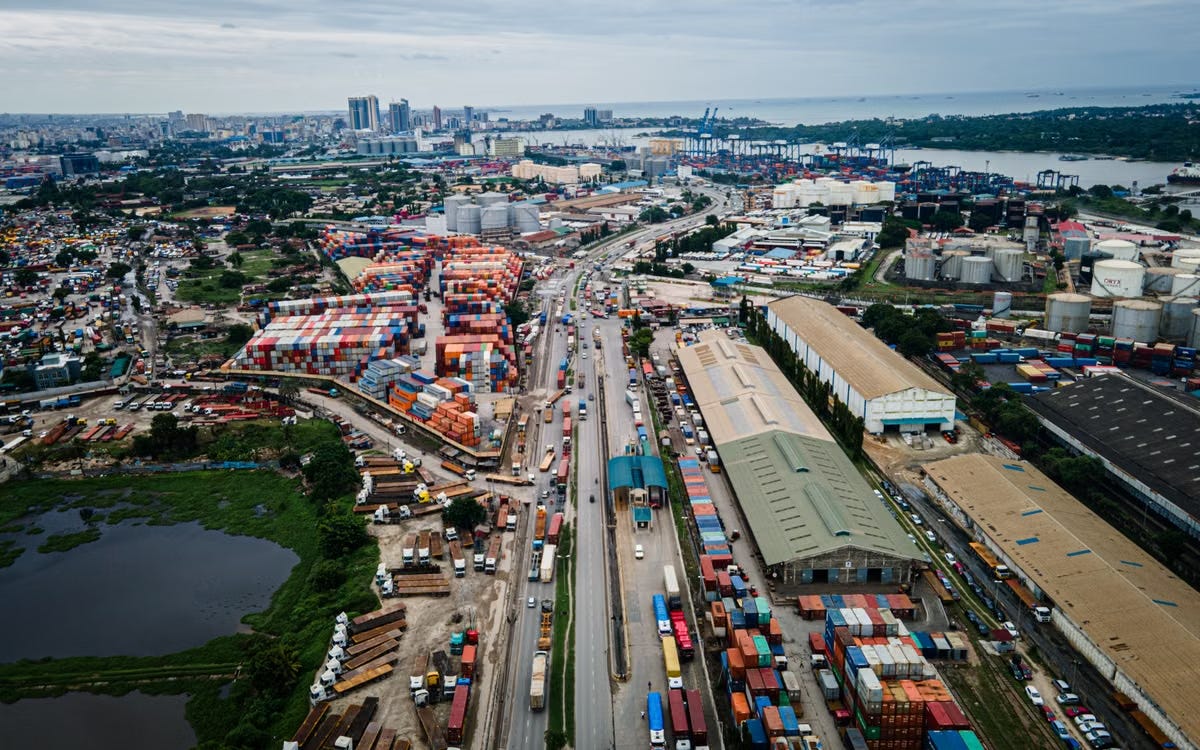
There is truth in the observation that Chinese firms benefit substantially from these arrangements. Yet this objection also risks missing the point. The relevant question is not whether Chinese firms benefit, but whether the resulting infrastructure, logistics networks, power systems, and capital goods leave recipient countries with greater productive capacity than they had before. Development has rarely been driven by altruism. The relevant benchmark is not motive but outcome, and the outcome of China’s presence in the developing world is increasingly one of an industrializer.
Ironically, several of the cities cited in the Foreign Affairs piece as victims of the “China squeeze”, including Addis Ababa, Nairobi, and Phnom Penh, have been major recipients of Chinese infrastructure, capital goods, and industrial investment. Their relationship with China is not simply one of competition. If China is truly “pulling up the ladder,” it is choosing an odd way to do it.
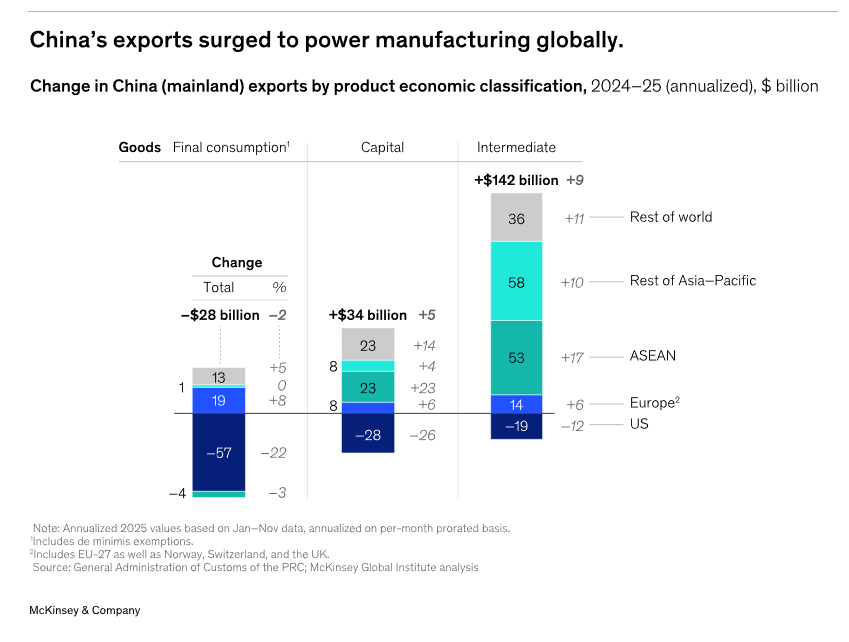
As McKinsey summarized in its commentary on China’s 2025 export trends:
“…rising exports of parts and machinery were not tied to replacing China’s lost US sales, rather they supported the expansion of manufacturing capacity in third markets, particularly emerging economies, deepening China’s role as a supplier of production inputs rather than a final-goods exporter.”13
So What?
If we assume that for now, China will continue to hold on to a chunk of low-end manufacturing that other countries wish could be theirs instead, no amount of finger wagging or emphatically argued policy papers is going to change this. Instead, the development task should be to analyze how other developing countries fit into this ecosystem and find something useful to do…or differentiate themselves in a niche.
What lessons can be learned from countries like Vietnam when it comes to learning how to dance with the industrial elephant that is the Chinese manufacturing sector? Considering Vietnam is industrializing immediately within a China-centered ecosystem, it’s unlikely they would describe this process as an “occupying the open space in the queue” maneuver. And while it’s not always unanimously rosy, a common-enough sentiment in Southeast Asian commentary seems to be they are also gaining alongside China, not being crowded out.14 So what policy mix is allowing them to participate and compete, despite China’s scale?
That’s where this China squeeze narrative is at its weakest. After identifying the problem, its proponents often slip into exhortation, as if strong enough criticism will prompt Beijing into repentance for its sins and reorganize its economy accordingly. Rather than identifying strategies for replicating the success of the more successful ASEAN countries, or emerging Chinese partners like Ethiopia, the oft-cited remedies have bare guidance for developing nations, amounting to little more than repeating the call for China to “make space” – i.e., give up parts of its industrial base so others can have them. The beneficiaries of such a strategy are not necessarily synonymous with the Global South as a whole, and developing countries may have very different interests.
The central failing with the “China is hurting the Global South” thesis is that it attempts to transform a complex set of questions about competitiveness, development, and industrial policy into a simple moral narrative. Once the assumed mechanics of industrialization and development are examined more closely, its empirical foundation starts to crack. And once we ask which countries would actually benefit from the proposed remedies - as opposed to being hurt by them - its claim to speak on behalf of the developing world becomes weaker as well. What remains is ultimately a normative argument about how China ought to behave as a major power. That is an argument one can make. But it is not a theory of development.
The label “China Shock 2.0” directly references the original “China Shock” associated with China’s WTO accession and the subsequent export surge around 2001-2008. While commentators generally date the second shock to the renewed expansion of Chinese manufacturing exports beginning around 2018, the phrase itself has been around in trade policy commentary since 2014 at least. It only entered widespread public usage in the last few years though, perhaps instigated by the April 2024 Wall Street Journal piece, “China Shock 2.0 Sparks Global Backlash Against Flood of Cheap Goods”.
A direct link to the Foreign Affairs article in question: https://www.foreignaffairs.com/china/china-pulling-ladder-behind-it?check_logged_in=1. But it is repeated in the authors’ other recent working paper at PIIE.
On the flying-geese paradigm and its East Asian developmental-state context, see Kasahara, UNCTAD; https://unctad.org/system/files/official-document/osgdp20133_en.pdf
A large development economics literature treats development as structural transformation and accumulation of capabilities, not merely the occupation of export niches. See, e.g., Hausmann, Hwang, and Rodrik on export sophistication; McMillan, Rodrik, and Verduzco-Gallo on structural change and productivity growth; and Rodrik (again) on premature deindustrialization.
Specifically, this image may be found at the PIIE working paper link at https://www.piie.com/publications/working-papers/2026/chinas-mercantilist-squeeze-developing-countries
For a recent commentary of India’s imports of Chinese imports, see this article from the Observer Research Foundation.
https://southasianvoices.org/ec-m-in-r-india-china-supply-chain-decoupling-06-26-2026/
Chinese manufacturing wages today average roughly USD $8/hour, versus roughly US $1-2/hour in India or Vietnam. See, e.g., India Today, citing The Economist. For historical Chinese wages, see CEIC data.
For example of recent coverage, see this recent Fortune/Yahoo News article: “China is becoming a ‘factory to the factories,’ powering global manufacturing in places like Southeast Asia even as U.S. trade declines”
https://juncturepolicy.org/glossary/terms-h/hegemonic-stability-theory/
See, e.g., this 2005 speech from then-Secretary of State Robert Zoellick in which he argued that China had benefited enormously from the existing international system and therefore had a responsibility to help sustain and strengthen it. He explicitly argued that China should become a “responsible stakeholder” in the order that enabled its success
https://www.mckinsey.com/mgi/our-research/geopolitics-and-the-geometry-of-global-trade-2026-update
See, for example: https://chinaglobalsouth.com/analysis/should-southeast-asia-fear-the-second-china-shock/
China shock 2 is based on the same fallacy as 1, zero sum game. As the belt and road and East Asian and BRICS development show growing exchange opens more opportunity for domestic economies prepared to compete. Flying Geese is being validated by global pattern of development. This postulates that exchange between higher and lower productivity countries gradually and stepwise diffuses increasing and demand and technology level, which state capacity can enhance or degrade but cannot greatly depart from in acceleration. It was never defined as a queue or automatic. The reason the china shock has no prescription but only moral judgment is because that is its purpose, to tarnish the reputation of china to slow the thinking of learning from china’s experience and bolster confidence in the American strategy of aggressive mercantile bloc. The latter is tangential from the root problem of industrial obsolescence in the advanced countries, which is fundamentally imbalanced automation and obsolete offering. On akamatsu’s ladder one steps up or is stepped on.
Great post. Very interesting and helpful read. And, yes, much of western countries' ceding of their markets for low wage goods was motivated by the need to maintain empire. Also true is that ceding these markets to Japan, Taiwan, Mexico, South Korea, and then China, was also intended to gut the power of labor in the imperial center. My hometown of Milwaukee, once the machine tool capital of the world, has never recovered. Ditto for the rest of the industrial Midwest.